
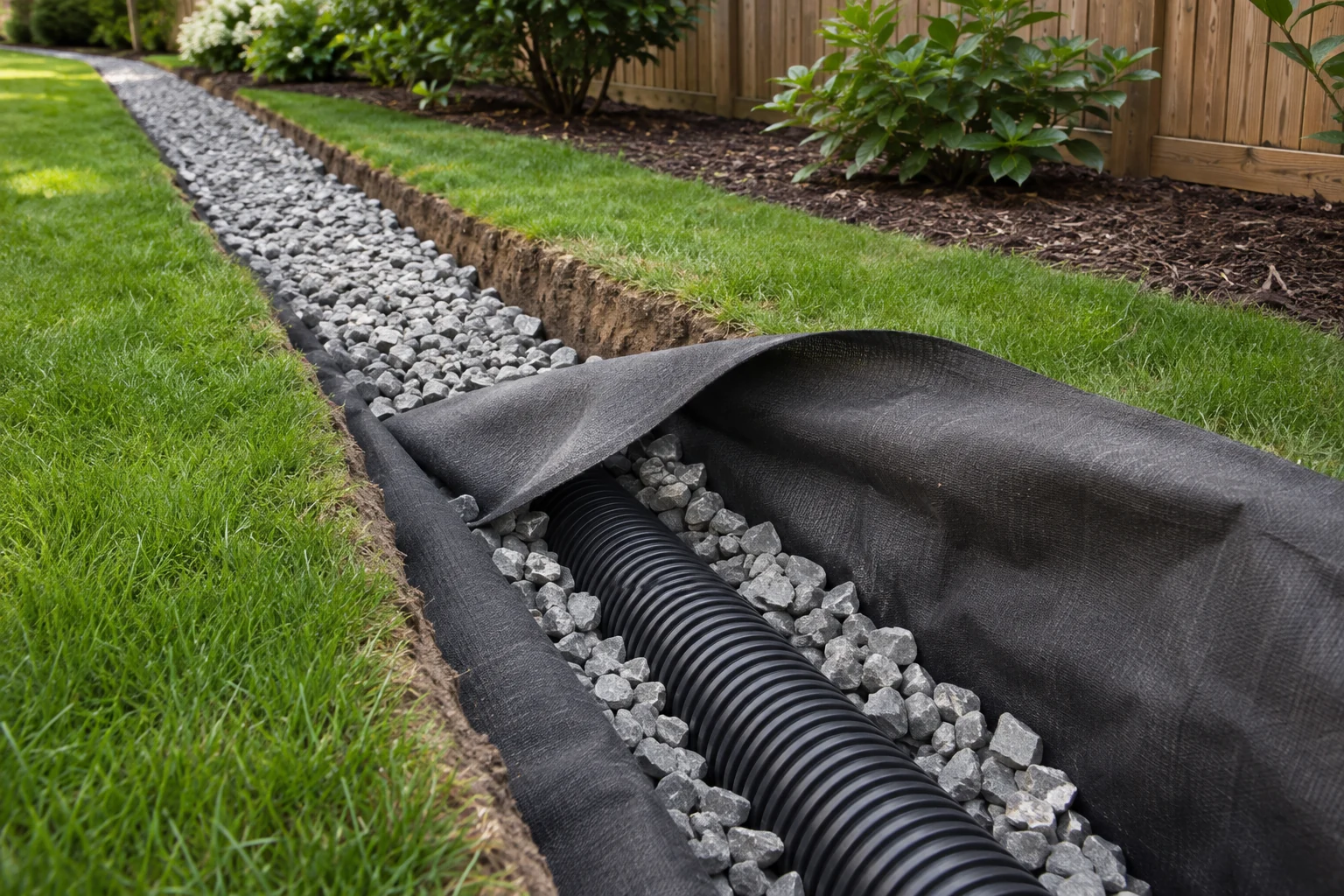
When part of your landscape stays wet long after the rest of the yard dries, a French drain may be worth considering. The important question is whether its collection method fits the water problem and whether the property provides an appropriate discharge route. Irri-Tex LLC lists French drain installation among its drainage services in Tyler and East Texas. Start with a property-specific discussion that connects the proposed system to the conditions you actually see.
What a French drain is designed to do
A French drain uses a trench with drainage aggregate to create a collection path for water. Designs commonly include a perforated pipe that carries collected water toward an outlet. Depending on the application, the surface may be finished with stone or another suitable treatment. The trench location, materials, and final appearance should follow the purpose of the installation rather than a one-size-fits-all detail.
It is helpful to distinguish this from a solid pipe carrying water from a surface inlet. Both can be part of drainage work, but they collect water differently. When discussing a French drain, ask what water it is intended to intercept, how that water enters the system, and where it goes afterward. Those three answers make the proposal much easier to understand.
Evaluate the symptoms before selecting the system
Repeated sogginess, wet planting areas, and moisture that appears along the base of a slope can prompt questions about a French drain. However, similar symptoms can have different causes. A sprinkler leak, an overflowing gutter, compacted soil, or a depression in the lawn may require a different first step. Observations over time can reveal information that a single dry-weather visit cannot.
Note whether the ground remains wet continuously or only after heavier rain. Record whether water is visible on the surface or whether the soil simply feels saturated. If you recently changed landscaping or added a hard surface, mention that too. These details help keep the project focused on the water source and its route rather than on installing a particular product by default.
Placement matters as much as the drain itself
A French drain needs to be positioned where it can intercept the water it is designed to manage. Installing it near a wet area is not necessarily enough. Elevations, adjacent slopes, soil layers, and nearby landscape features influence the route. The useful length and depth depend on the site and the collection objective, so a universal trench size is not a reliable starting point.
Walk through the proposed path and discuss what will be disturbed. Trees, established beds, fences, existing irrigation, and buried utilities can affect the layout. A route that is easy to draw may be difficult to access or maintain. Ask how the design balances effective collection with the features you want to retain. The resulting scope should describe an installation suited to the property rather than a standard package.
Make the discharge route part of the decision
A collection trench must be considered together with its outlet. Water cannot reliably leave a system if the downstream route is obstructed or unsuitable. Available fall, outlet elevation, and conditions beyond the collection area all affect the plan. It is important to understand what happens when the receiving area is already wet, particularly during a longer period of rain.
Ask to see the proposed outlet location before approving the work. Discuss how it will remain accessible and how the surrounding area will be protected from concentrated discharge. Connections to public drainage infrastructure or routes near a property line need appropriate review. A French drain should not simply redirect a homeowner's problem toward a neighbor or an unverified destination. The entire water path deserves a clear explanation.
Choose the visible finish with everyday use in mind
Drainage work becomes part of your landscape, so the finish matters. A visible stone strip may be appropriate in one area and inconvenient in another. A route across a heavily used lawn or beside a walkway should account for mowing, foot traffic, and access to collection and maintenance points. Discuss the intended appearance before excavation rather than after the trench is in place.
Ask what restoration is included and what will require additional work. The scope may need to address disturbed turf, bed edging, displaced mulch, or sections of irrigation affected by the installation. Soil settles and landscapes change, so clarify what to watch for as the area returns to normal use. A practical plan considers both drainage function and how you will care for the finished space.
Compare a French drain with surface drainage
If water races across a patio or collects quickly in a low spot, a surface inlet may deserve consideration. Surface drains capture visible runoff at their openings. A French drain collects along its trench and is often discussed for persistent wetness or subsurface interception. Depending on the property, the two approaches may work separately or form part of a broader drainage plan.
You do not need to settle the technical choice before requesting an assessment. Tell Irri-Tex what you notice during rain and how the ground behaves afterward. Ask why the proposed approach suits those observations and whether another method would address the same concern. A useful comparison explains collection behavior, maintenance needs, landscape disruption, and the outlet arrangement rather than relying on the name of the product alone.
Ask about access and long-term care
All drainage installations deserve periodic observation. Soil movement, roots, sediment, vegetation, and changes to the surrounding landscape can influence how a system performs over time. Maintenance access can be especially valuable when much of the installation is below ground. Ask where inspection or cleaning access is provided and what routine care is appropriate for the specific design.
Keep a simple record of the installed route, outlet, and any accessible points. Before adding a fence, planting a tree, or changing a garden bed, refer to that record. If the original wet area returns, note when it happens and whether anything has changed nearby. Early reporting gives a contractor more useful information than a general statement that the yard is wet again.
Request a French drain conversation in Tyler
An estimate becomes more useful when it describes the actual site. Be ready to discuss access, the area of concern, nearby landscaping, and any drainage work already in place. If an older system exists, share whatever records you have and explain whether it previously worked. Unknown buried conditions may still require further evaluation, so clear communication about scope is important.
Call Irri-Tex LLC at (903) 752-4861 to discuss French drain installation in Tyler or service availability for your East Texas property. Explain the symptoms you want addressed and ask about the next step. The goal is a clear plan for collection, routing, discharge, and care, with realistic expectations about the conditions the installation is intended to manage.
French Drains: your questions answered
Is a French drain the same as a trench drain?
The terms are sometimes used loosely, so ask for a description of the proposed system. A French drain commonly uses aggregate and a perforated pipe below or near the surface. A grated channel drain collects surface runoff through a visible linear opening.
Can a French drain work on a flat property?
The answer depends on the available elevations, collection area, outlet, and overall design. A visually flat yard still needs measured evaluation. Do not assume that burying a pipe alone will create an effective discharge route.
Will the drain eliminate all wet soil?
That should not be assumed. The system has a defined collection area and capacity, and its performance depends on soil, rainfall, outlet conditions, and maintenance. Ask which symptoms the proposed work is intended to improve and which may remain.
Should I add more soil over the wet area first?
Discuss the drainage plan before changing elevations. Adding soil can alter surface flow, cover existing collection points, or shift water elsewhere. The appropriate sequence depends on the cause of the wetness and the layout of the property.
Who installs French drains in Tyler, TX?
Irri-Tex LLC lists French drain installation for Tyler and East Texas properties. Call 903-752-4861 to discuss the affected area, water source, and property location. A suitable design depends on the full collection and discharge route, not just the length of a visible wet spot.
How much does French drain installation cost?
A useful quote accounts for the proposed route, excavation, materials, outlet, access, and restoration. Existing utilities and hard surfaces may affect the work. Ask for an explanation of those items and the intended outcome before comparing prices for different drainage proposals.
Let’s talk about your property.
Contact Irri-Tex LLC at 903-752-4861 to discuss french drains in Tyler and East Texas. Share your location, what you’re seeing, and what you’d like to accomplish.
Start a project conversation